Pulse Check Round-up #13
Hi all,
Apologies for the late round-up. I’ve had an untimely combination of various travel and illnesses over the last few weeks, which has made it tough to sit down and write this thing.
As a result, some of these topics feel a little dated and not as relevant as I was hoping for. Hope you still enjoy.
Next survey is available here.
Survey Results
Q1: What is your average phone screen-time?
Results Summary:
Minimum time: 1hr 44min
Max time: 9hrs
Mean: 4hrs 13min
Median: 3hrs 37min
Highlighted Free Responses
“. . .The days it is higher are FaceTime with family and friends and since I live abroad I feel that doesn’t really count! But most weeks I am in the 3-3.5 hour range. Still feels like a lot of time but definitely less than it used to be so I’d say I’m neutral not quite at proud”
“. . .Seeing that I spend 5 hr a day staring at my phone makes me feel pretty lame and sad. I def spend a lot more time on my phone when I’m bored at the office, which has been true the last couple weeks.”
“. . .I’m ashamed to say that I probably average like 9 hours a day because I watch a lot of tv on my phone at work, fill out my friend’s survey, play games for nerds, etc. I’m hopelessly addicted to Al Gore’s internet.”
“. . .Although I don't think my screen time average is particularly egregious compared to US adult average, thinking that I spend 15% of every day on average on my phone is quite depressing and feels like I'm wasting my time.”
“high, I blame GPS”
“Neutral because I often leave my phone open to listen to youtube vids (prank calls, interviews, true crime) or have Pokemon Go running. I should try to avoid Reels before bed though.”
“Needs to be lower. I had to buy a Brick to get to less than 4h”
“I'm not ashamed of my screen time but I do think I need to be on my phone less. I notice I'm happier with less screen time and have been actively trying to lean on it less.”
“I apologize but I do not track my screen time at all and I’m not going to start now. After increasingly trying to optimize my life on and off for several months I realized adding the additional metric of how much screen time I have was both making me more stressed and not telling me anything.”
“Most of it is Instagram and YouTube. YouTube is fine because I think that type of entertainment is more engaging and not brain rot but Insta is fully just brain rot time.”
“I have gotten it down but want to get it more down. I should delete Instagram”
“Decently proud, and thought it would be a more.”
Commentary:
As of writing this, my most recent weekly average of screentime was at 4.5 hours a day. But I’m normally more in the 3 - 3.5 hr range, I swear.
To make some excuses for myself (as some of you have), a good amount of my screentime is taken up by having the NYT cooking app open while I’m making dinner or listening to something on YouTube on my phone at work (boredom at the office has definitely increased my screentime as of lately). But that still doesn’t explain the other 2-3 hours a day I just spend doomscrolling and brainrotting.
Some of you have reasonable justifications too: an hour on FaceTime and GPS are more like utilities of daily life -- not the same as an hour on TikTok.
Despite the excuses we make for ourselves, there definitely is an undercurrent of shame and embarrassment about our screentime in the responses. We all now seem to have internalized the idea that high screentime is generally bad and we spend too much time on our phones. It’s like the new health fad or moral panic. Are you keeping your screentime down? Are you avoiding microplastics? Are you getting enough protein?

As a result, there seem to be no shortage of different schemes and tricks that people employ to be on their phones less. As mentioned before, for a while I was paying real American dollars for a subscription to an app that would make me do push-ups to get screentime minutes for Twitter and Instagram. Others (including one of you) seem to be warming up to that Brick thing that shuts down access to your phone. Around DC, I’ve been seeing a lot of flyers promoting a program that gives you a “dumb” phone in place of your smart device. Some have tried a concentrated form of digital detox, such as “Month Offline,” a meetup group where people give up their smartphone in their daily lives.
Some people go even dumber than that:

This is going beyond just the individual and the domestic: there are increases in phone-bans at concerts, a proliferation of phone-free bars, and social media bans in other countries. And now it’s reached an institutional level, as seen with Meta’s new restrictions on teen usage on Facebook and Instagram.1
From what I understand, the legal argument against Meta and teen safety has been similar to the legal arguments against Big Tobacco in earlier decades. They knew their product was addictive and bad for people, but they plunged ahead regardless. When thinking about it this way, it’s hard not to view screentime as too dissimilar from cigarettes: unhealthy, addictive, and in many ways hard to avoid.
Regardless of our situations, I think we could all probably do with less screentime. Except for completing my surveys and reading my newsletter. You get a pass for that.
Q2: What is your most used emoji?
Results Summary:
Leading emoji: 😂 3 votes
Other options (1 vote each): ☺️💯🔥😇😈😎
Highlighted Free Responses:
“For some reason I always use that heart rather than the bright red one… I have no idea why but I’d say it says I’m in touch with family and friends and also have had some hard life stuff lately so ♥️🥰😭 are my three top which feel pretty fitting. Also I do a lot of :) still which I think means I’m getting old”
“I tip the people who cut my hair on Venmo with this emoji and I cut my hair pretty frequently. Also don’t use emojis so much”
“That I think I’m cooler than other people and that the kids would say I’m unc”
“What can I say? I'm old.”
“(Purple Devil) I think it means I’m a stinker. I generally don’t care for emojis and don’t have a lot of use for them (sticker supremacy), and so when I use that it’s usually in the context of me saying something mind numbingly stupid or inane, with the added benefit of purposefully misusing an emoji.”
“That I ask for things kindly 😇”
“meh I'm basic af”
“Flirt flirt flirt”
“we have to elevate everything from lol to lmfao now, just smiling or a "haha" isn't enough”
“I must make a lot of requests from people as its kinda like a "pls" emoji”
“I'm hip”
Commentary
I remember in high school when a friend told me that he didn’t feel that he “had enough social capital” to use emojis regularly. At the time, I honestly kind of empathized. But now emojis feel like a required part of our modern vernacular, and they’ve become a distinct vocabulary of their own.
Just like regular words, emojis have their own connotation and layered meaning. Using the right one in the right context does take some skill and feel. There are constantly shifting trends to their meaning, vibe, or associations. And how you use emojis can suggest something about your age, gender, race, and interests.
I was motivated to ask this question after seeing this NYT article about emoji usage, which discusses the differences of emoji use across different demographic groups.
😭 is standard fare for the youths. 😂 might as well mean you’re ready for AARP. If this data is any indication, you guys are chopped 💀
As some of you mentioned, there is something of a textual inflation. “Lol” is now worth less than pennies, “lmao” is the base unit of expressing laughter.

In hindsight, I think my friend was right about using emojis. Using them effectively and in a certain manner does convey some level of social cache or communication dexterity. But now they’re not just a secret language for popular teenagers — emojis are commonplace in workplace emails or production codebases. Whether you’re communicating with your coworkers or your friends, it actually behooves you to be emoji literate.
One observation from the NYT article is that linguistically, in emojis and otherwise, we are all following the trends of teenage girls. So maybe, in order to keep up with the times, it would be good if I knew more young girls. Wait, shit. No — not like that. I take it back. I didn’t mean it!
Q3: How often do you put on sunscreen?
Results:

Highlighted Free Responses
“Absolutely yes everyday! Living at 9000 ft will also teach you that even a day without can be bad bad so I don’t risk it”
“Started using it on my face in the last few years & I use it strategically on my body to tan (apply less than the doctor ordered). I buy Japanese water essence sunscreen at Teso Life — much better than US brands”
“. . . I have a coworker who is 40 but looks much younger bc she has great skin since she wears a lot of sunscreen and that is aspirational and she motivated me to keep face sunscreen at work.”
“I feel like I should wear face sunscreen more regularly, but I usually forget or it doesn't mix well with my makeup”
“. . .I rarely use sunscreen. Can’t stand the stuff. Smells weird, feels terrible on my skin. The feeling of sunburn genuinely does not bother me anymore. It’s the only way I don’t look like Casper the Friendly Ghost.”
“I realized that all the young tan people I knew have already started turning into lizard people; accordingly I started getting a lot better at using sunscreen.”
“I recently saw a meme about white people on vacation and how it’s them applying sunscreen 24/7 and it made me laugh cause before college I truly rarely wore sunscreen unless I was going to the beach, and I would rarely reapply. That being said, I definitely have been making more of an effort to increase my use of sunscreen-it’s so important!!!! People in the Caribbean just haven’t caught up lol”
“Face sunscreen every day - I'm a white man so I age terribly, sunscreen is my tiny act of defiance against the inevitable march of wrinkles and spots. . . As a side note, this would all be resolved if we could have more access to foreign sunscreens!”
“Became very conscious of it and use face sun screen everyday and anytime I go out”
“it really should be every day, but that's what botox and chemical peels are for”
“"Ladies and Gentlemen of the Class of 2026, Wear Sunscreen". I like the grad speech that was actually never given and the song "Everybody's Free (To Wear Sunscreen)" by Baz Luhrmann believe it or not.”
“I've never really used it till recently and I can actually say there's benefit to it now...lol”
Commentary:
The whitest people you know really don’t be wearing sunscreen. Smh.
I appreciate that at least most of you acknowledge you should be wearing sunscreen, or at least accept the benefits. As for the rest of you, get a grip.
I also at least appreciate that I don’t detect any of the MAHA / RFK coded takes that treat sunscreen as fake, woke propaganda, which seems to be contributing to some sunscreen skepticism.
There also seems to be some Gen Z-flavored nihilism against sunscreen, although some of that might just be young people being young people and acting like they’ll never get old. And some of it may just be that people in general are getting stupider.

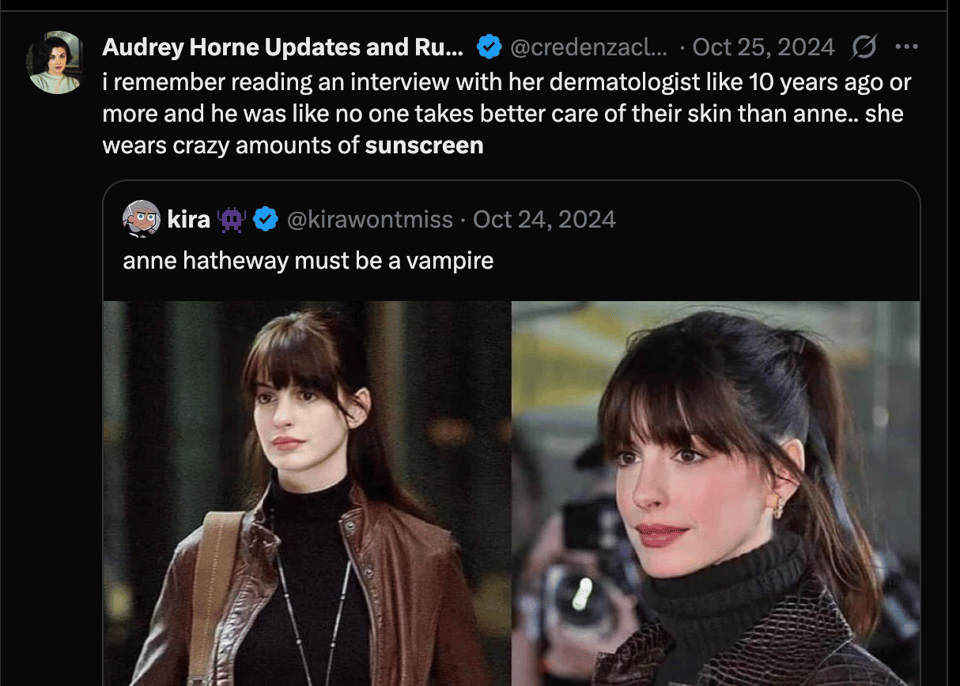
Something that I learned while looking into this topic is that one out of every five Americans is affected by skin cancer. Even if you don’t care about getting a sunburn or getting wrinkles, that should at least make you a little more conscious.
Of course if you don’t trust the scientists, you can always trust ageless wonder Anne Hathaway:
Q4: Do you track any of your health data / biometrics?
Results

Highlighted Free Responses
“Not for me! Too much health anxiety”
“Not curious at all. Listen to your body not your watch”
“With so much to be stressed about in the world, why do we need to obsess ourselves with biometric stats that for most of us have no real impact on our quality of life? . . . Also I think it’s really fucking stupid that most of them operate on a subscription model to use this tech. If you’re paying for this you’re a chump!”
“As a woman who is constantly bombarded with weight loss content/ads/messaging and has friends and family members who struggle with eating disorders and unhealthy relationships with exercise, I think it would be a slippery slope to focus on metrics.”
“Much like my paranoia about FaceID and screen time data, I don’t want Apple really knowing anything about me. If it were up to me, they wouldn’t even know my name or have my credit card on file.”
“I like seeing metrics when I’m training, I don’t like my watch preaching at me that I shouldn’t have a beer and that I’m not ready to train. Like fuck you dog, you work for me”
“Nah, there’s no need to track things that closely unless you have or are at risk of developing a chronic disease. . . I think it’s a slippery slope of fake news and unnecessary hysteria.”
“Mainly sleep and exercise. I don't use the advanced metrics, but it does help me be more aware of my sleep patterns and I have found myself modifying my habits to try to improve my metrics.”
“I use enough screens so don’t want to add another one. Seems like some people who do are making their life a rpg”
“steps, calories, sleep hours. Mostly I use the sleep hours to blame my lack of focus and terrible mood. Then I use the steps and calories to feel guilty or justify how much I ate.”
“Yeahhh I've had a Whoop for a few months now and almost never take it off. TBH it pretty much tells me what I already know but it's pretty cool to see all of the data in one place. Also the AI feature is pretty interesting and gives you tips based on your biometrics. Altogether, it's helpful for sleep, and exercise and totally makes you realize how bad alcohol actually is for you lol.”
“I go straight off feel”
“I like tracking my sleep. I feel like tracking time helps me be more consistent in getting enough sleep. The sleep score is kind of irrelevant to me though because I don't know how you would even stop minor wakeups in the night. Also I like when I drink and the next day the vitals tell me I'm going to die.”
Commentary
I think I’m with a lot of you guys. I think tracking metrics is generally kind of unnecessary for most people, and can have the negative effect of perpetuating Optimization Brain and a Sisyphean obsession over your health numbers. Like that Bryan Johnson guy who tracks his boners. Do you really want to live like that loser?
I also agree with the sentiment that you probably don’t need a smart device that’s harvesting your data to tell you how to live a healthy life. I’ve had stretches where I’ll wear a smart watch all day and keep track of things like my sleep and resting heart rate. But at the end of the day I didn’t really feel like it was telling me anything I couldn’t figure out on my own. Like yeah, I know I sleep like shit when I have 2 beers. I know I need to rest after a big workout. Not exactly rocket science.

I think I’ve written something to this effect before, but my take is that the general principles of living healthy have basically always been the same. Get enough regular sleep, eat a balanced diet that includes fruits and vegetables, don’t eat too much processed crap, don’t over indulge in drugs and alcohol, get regular exercise, poop 3 or more times a day. You know, basic stuff. You don’t need a watch to tell you those things.
Although I’ll admit the health metrics are helping some people get healthier. I have a friend who finally decided to stop taking Zyns because his smart watch told him his resting heart rate was too high. Although he got to the right answer eventually, it took him a $200 watch and a $150 yearly subscription. I guess he’s saving money on Zyns now so maybe it’s all a wash.
Lastly: all the smart watches look stupid. I don’t know why we as a society normalized so many guys wearing an Apple Watch to formal events or with a suit. Pip-Boy looking ass.
Q5 Free Response Option
Survey Results

Highlighted Free Responses
“I did maybe in high school but just not my thing!”
“My mom had some Lucinda Williams albums but my household was more folk than country-leaning. I listened to a lot of Patsy Cline during a breakup like ten years ago and then watched Ken Burns’ Country Music series when it came out and it was a conversion experience, now I can’t get enough. I like all of it — Nashville, Bakersfield, alt-country, cosmic-country, classic-country, cheesy 80s-90s stuff that my boyfriend calls “Trish” genre…”
“I like classic country and the folkier stuff well enough but am not ever seeking it out”
“I love country music unironically. I think it's totally fine to not prefer country music as a genre, but I do feel like a lot of our generation's disdain for country music comes from a pretty elitist space. That being said, like many genres, country music has a history of racism that obviously isn't great, but I do think there are a lot of great artists who push back to claim a genre that tries to be welcoming.”
“Country music is not a monolith so you cannot easily say you don’t like the entirety of the genre considering it’s one of the core ingredients of rock music. To say you don’t like country is to say you don’t like rock, rap, or pop music. It’s too broad to classify under one umbrella.”
“I’m very open with music, but country music I just really can’t get behind. Don’t really enjoy it at all. Closest I can do is folk (if we even consider that adjacent to country).”
“If I’m in the south it’s good”
“only ironically or when it's AI-generated. like what even is the point otherwise?”
“I like the classics . . . that's some of the best music ever written in my humble opinion . . . But modern country isn't my cup of tea.”
“If it's on out in public, like a restaurant, I'll listen but I never listen on my own free will.”
Commentary
I don’t personally have anything against country music, although I don’t think it’s ever really going to be my main thing. I rarely put it on purposefully — at most I’ll listen to the Emmylou Harris record I got from a friend as a gift or the Fallout New Vegas soundtrack.
When I was a teenager getting into music, hip-hop was the cool and subversive genre. White suburban kids used to want to pretend to be Black (or at least Eminem). Country was largely considered déclassé, reserved for hicks and rednecks. The less offensive take would be to say that you don't like the pop-country stuff, but are more into the “the more folky, rootsy, Americana, bluegrass” type of thing.2
But now that country music is the genre-de-jour, kids want to be White again, as long as they’re in “God’s Country” and get to larp as rough and rustic. Outside of a couple recent Drake songs, you can hardly find any hip-hop or rap on the top charts today. The song of the summer, if there is even such a thing anymore, is almost certainly Ella Langley’s “Choosin’ Texas,” which has been the #1 song in the country for multiple months straight now. Similarly, the rest of the Billboard Hot 100 is littered with other country tracks from Langley, Stella Lefty3 and Morgan Wallen.
Having spent my college years in Nashville seeing upper-middle-class white kids from Evanston and New Brunswick cosplay as country in their cowboy boots on a weekly basis, this cultural moment is not unfamiliar to me. Now it’s just broken containment from the SEC into the masses (insert NCAA conference alignment joke here).
Not to get too “This Week on Twitter,” but now New Yorkers are noticing an increase of college football-watching, parlay-betting, Morgan Wallen-listening, cowboy-boot-wearing, Dave Portnoy-enjoying, Big Ten / SEC - hailing, Greek-life-pledging post-grads infiltrating their Brooklyn and Manhattan haunts.
Some have come to refer to this populace as “America B”, a pithy but undeniably pejorative term to broadly describe a growing flavor of mainstream American culture today. That’s definitely a reductive way of describing people (not unlike describing things as “co-worker”, or “NPC”), but you can place this concept in the same neighborhood as some other trends: the “man-o-sphere,” the second Trump administration, an over-correction away from “Woke 1”, and the “national divorce” that’s been in motion for the last several years.
Whatever you want to call it, I can’t say I really like this trend that the growing popularity of country music might suggest. But I can’t tell if it points to some deeper issues in our society, or if I’m just getting older and I’m trying to do some mental gymnastics trying to figure out why the kids of today have it all wrong.

At the very least, we can all agree on Dolly Parton. RIP.
Next Survey
See here for the link to the next survey. I’ll be closing this on Friday, September 25th.
Cheers,
Nathan
Why shouldn’t we have these settings for everyone else too?
Julia recently aptly compared that to saying that you only like socially conscious rap. Which is to say, a very narrow slice of the genre.
The daughter of a billionaire who founded Groupon, raised in Glencoe, IL. Very country.